Saliency: how painting reflects on the shaping of memory
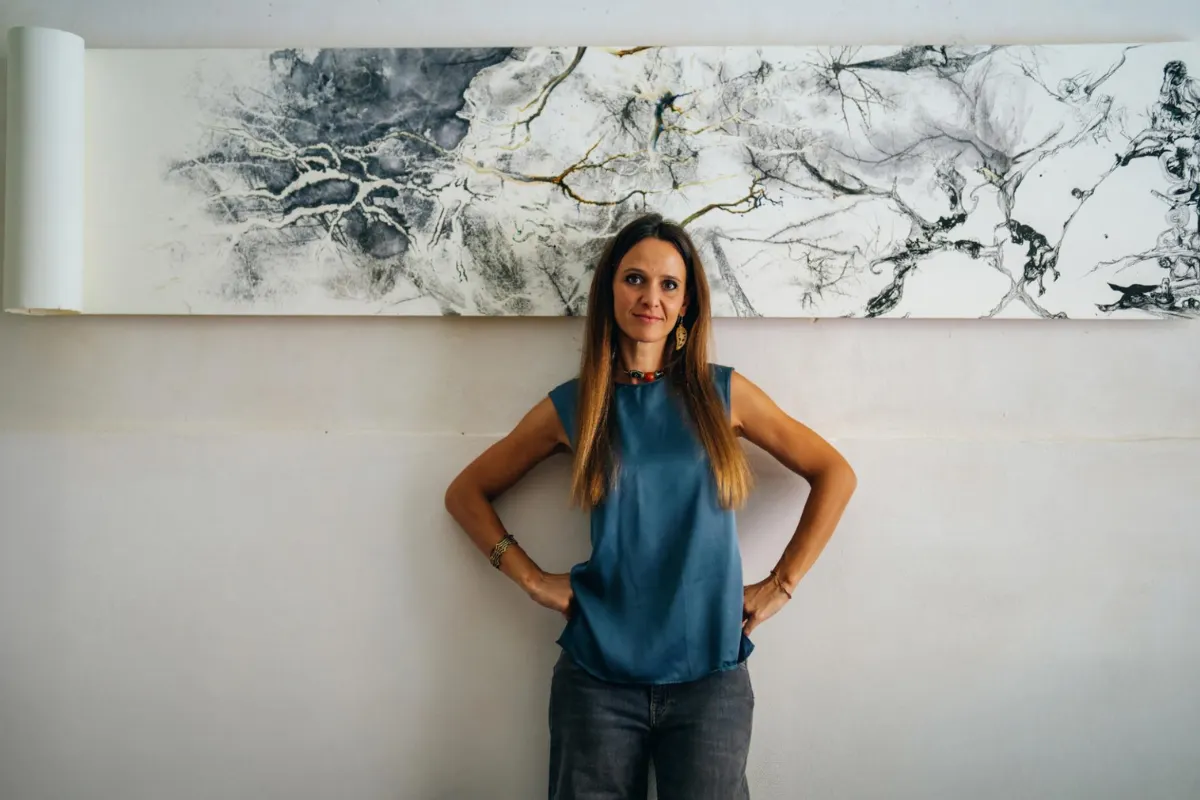
Saliency How painting reflects on the shaping of memory Serena Scapagnini discusses Saliency, La Memoria Cangiante, the permanent installation created for the Wu Tsai Institute at Yale: a journey through neuroscience, memory, and perception to explore how the brain continuously selects, modifies and recreates our memories. by Giorgia Basili Saliency, La Memoria Cangiante is Serena Scapagnini’s new permanent installation, inaugurated on June 4th and conceived for the Wu Tsai Institute at Yale University. The artist’s work draws on studies in perception and neuroscience, exploring how our brains rework lived experiences and continually selecting and modifying stored memories. What role does memory play in our perception of time and space, and in our identity? The constant fluctuations of memory alter the image we have of the world and of ourselves; what we choose to focus on, to nurture in our minds as memories to be cultivated, impacts the quality of our existence. And if the madeleine tasted by the protagonist of À la recherche du temps perdu has the power to reawaken his childhood memories, it is no coincidence. Something has remained attached to that flavor and the trace of what has been resurfaces like a wave, launching itself onto the shore of consciousness only to then retreat and resurface with new fragments of salt and shell. Serena Scapagnini at work on site installing “Saliency, La Memoria Cangiante”, Wu Tsai Institute, Yale University, USA, 2026, installation view, ph. Ian Christmann What did the one-year interdisciplinary residency (2025–26) at the Wu Tsai Institute consist of, and how did it come about? My research on memory is the origin of the inspiration for a collaboration with the Yale Wu Tsai Institute, the primary institute at Yale dedicated to the exploration of neuroscience and cognitive psychology. I was invited to work in their Artist-in-Residency program, following my collaborative project with the Yale Quantum Institute (YQI), which in turn grew out of more than 13 years of shared work with Dr. Michael Higley, Professor of Neuroscience at Yale. At the YQI, my dialogue with the quantum physics researchers shaped a project, Superposition, that is structured as a cycle of works. Through drawings, engravings, painting, and installations, it explores quantum superposition, the ability of a particle to exist in multiple states simultaneously. This concept also serves as a metaphor for identity, memory, and perception. Indeed, quantum memory continues to exist at the center of my research, with works focusing primarily on liminal spaces—between memories and their dissolution through contact with the external environment, blending with the rest of the universe. How did you interact with neuroscientists and cognitive researchers? My work at the WTI developed in profound synergy with the Director and Professor of Psychology, Dr. Nick Turk-Browne, unfolding through a deep immersion into the institute’s ecosystem. This experience ranged from sophisticated research laboratories studying robotics, cellular engineering, neural development and perception, to numerous scientific discourses on the nature of memories and the phenomena of saliency. Together, we explored the mechanics of what mental information we retain and the underlying processes of selecting memories to preserve or discard. In particular, my creative inquiry focused on the specific roles that emotions and the body play within these neurological systems, investigating what ultimately clings to the walls of our memory and what slips away, re-emerges, resurfaces, and disappears. It is from this rich environment, following 13 years of creative dialogue with the Higley Lab and the AiR program at the Quantum Institute curated by Florian Carle, that Saliency – La Memoria Cangiante was born: a project that celebrates and embraces these various stages of the journey. Serena Scapagnini, Saliency, “La Memoria Cangiante” (detail), Wu Tsai Institute, Yale University, USA, 2026, installation view, ph. Ian Christmann Salience refers to the cognitive process by which certain details emerge while others recede into the perceptual background. What struck you about this process, and what did you discover from your interactions with researchers? My time alongside the researchers at the WTI allowed me to study the phenomena of saliency in relation to the processes of the mind, discovering that it possesses a nature that is mutable and reflects the significant biological plasticity that exists; a fluid reality that echoes a historical, intuitive human awareness. When Pablo Picasso stood before the Paleolithic cave paintings of Altamira, he observed that tens of thousands of years before scientific theories of perception emerged, early humans had already developed sophisticated strategies to make the intrinsic spirit of the image visible. The bison, shaped by the curvature of the stone, intensified through mineral pigment, and positioned to guide the viewer’s gaze, demonstrate an intuitive understanding of visual attention by the artist. The study of the phenomenological tradition teaches us that the eye is not merely a receptor of light; it is a creator of worlds. The paintings of Altamira represent one of the earliest human expressions of saliency—the distinctive perceptual quality that allows certain forms and ideas to rise to prominence. Observing the dynamics of memory, we discover how its retrieval inexorably modifies and selects certain details, completes missing links, and creates a continuum between what is revealed, what is hidden, and what appears lost. Hence, images from our memories are always imperfect and potentially mutable, like the artwork that derived from these reflections. At the center of the installation is a painting that embodies a shared reflection on how the brain selects, transforms, and reconstructs experience over time. The installation features a painting at its center. The blue wave embodies a reflection on how the brain selects, transforms, and reconstructs experience over time. Can you explain how you captured this concept in image and color? Several questions emerged from our dialogues at the WTI, including what role memory plays in our perception of time, space, and identity. We well know that nothing is static and that memory changes over time. In evoking a memory, the observer inexorably interferes with the object of their gaze. They participate in, and therefore influence and “rewrite,” past, present, and future simultaneously.
Serena Scapagnini
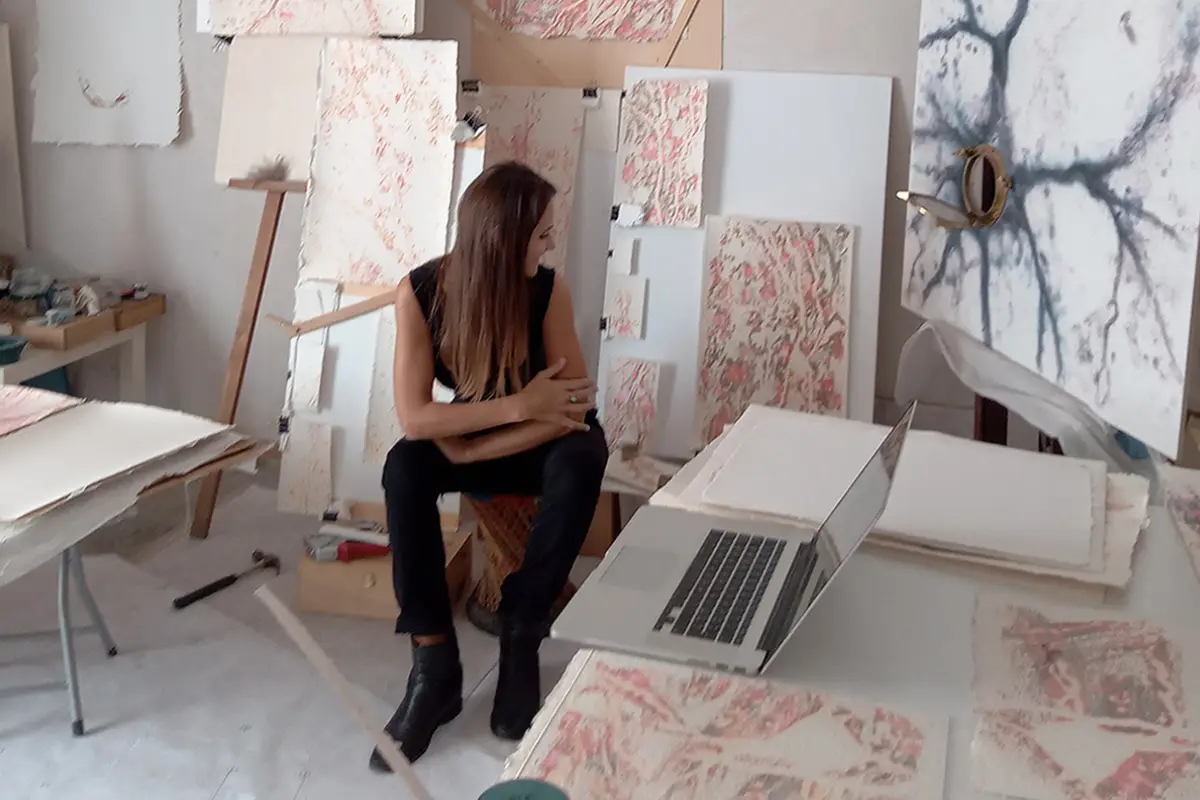
Serena Scapagnini Visita a Studio Serena Scapagnini ha studiato semiotica e storia delle religioni alla Sapienza di Roma, e ha proseguito gli studi in storia dell’arte medioevale all’Università di Siena. by Nicolas Martino Parallelamente alla formazione teorica ha completato la sua formazione artistica all’Università di Paris 8 (Vincennes) – sede universitaria che vanta un’importante tradizione d’avanguardia avendo avuto tra i suoi docenti Jean-François Lyotard e Gilles Deleuze – e alla School of Visual Arts di New York. Dal 2012 ha iniziato a collaborare con il centro di ricerca sulle neuroscienze dell’Università di Yale. Tutti questi diversi interessi, che tengono insieme immagine, filosofia, religione e scienza, si sono integrati in una pratica artistica che indaga la connessione funzionale tra le cellule, ovvero le sinapsi, nel tentativo di cogliere, attraverso l’uso di videoinstallazioni, ma anche del disegno e della pittura, il segreto delle misteriose alchimie attraverso cui prendono forma il pensiero e la coscienza umane. Un lavoro difficile, sia nella sua fase progettuale, che rimane sempre legata al dato scientifico, sia nella restituzione, che cerca di tradurre poeticamente un processo biologico. Quello di Serena Scapagnini è un lavoro che si segnala per la capacità, invero rara, di tenere insieme ambiti di ricerca diversi, mostrando concretamente come la divisione tra cultura umanistica e cultura scientifica non abbia ragion d’essere, e ancora più profondamente e significativamente, mostra come la ricerca scientifica, nel suo procedere, sveli verità che da sempre sono celate nel linguaggio poetico delle religioni, ovvero svela quanto ciò che è antico – e per molto tempo si è ritenuto di dover superare in quanto prodotto della superstizione e di un rapporto non scientifico con il mondo – sia incredibilmente attuale. La scienza stessa, man mano che ha superato molti dei suoi pregiudizi positivisti, apre scenari che rimandano alla parola poetica, e quindi all’arte, alla capacità di indagare la realtà in alleanza con altri saperi. Chi può dire la meraviglia del mondo se non un poeta conscio della bellezza che si nasconde in una formula matematica? E quindi, chi può raccontare la magia del nostro pensare e del nostro sentire se non un artista che abbia anche una formazione scientifica? In questo senso la pratica artistica di Scapagnini rimanda ad altre epoche, al Rinascimento, in particolare, quando l’artista era anche un filosofo e uno scienziato (a volte anche un mago e un ingegnere), una condizione che nella ristrutturazione dei saperi che attraversiamo da alcuni decenni sta ridiventando sempre più comune. Mentre visito il suo studio, l’artista mi racconta il nuovo progetto a cui sta lavorando: dopo aver studiato ed esposto in giro per il mondo, torna in Italia, e a Roma in particolare, con un progetto site specific per la Fondazione Volume, a cura di Mario Codognato, che inaugurerà il prossimo 30 novembre, seguito subito dopo, il 4 dicembre, da una mostra da Erica Ravenna che rappresenterà un ulteriore sviluppo dell’installazione pensata per gli spazi di Francesco Nucci. Questo prossimo doppio appuntamento romano si può considerare come il punto d’arrivo di un lavoro avviato ormai dieci anni fa – al 2012 risale l’avvio della sua collaborazione con la facoltà di medicina di Yale – ed è quindi uno dei più importanti del suo percorso artistico. Un’installazione toroidale immergerà il visitatore dentro il dispositivo connettivo fatto di neuroni e sinapsi, insieme a una serie di disegni realizzati su carta preparata appositamente dall’artista. Mentre me ne parla mi viene in mente la metafora buddista della rete ingioiellata di Indra, con la quale si esprime l’universale interdipendenza di tutti i fenomeni, fuori e anche dentro di noi, una metafora che oggi sembra particolarmente adatta a raccontare la nostra condizione al tempo dell’Antropocene. Probabilmente il lavoro di Serena Scapagnini dovrebbe trovare più occasioni di essere visto in Italia, ma questo dipenderà anche dalle sue scelte. E questo non lo si dice certo per un qualche particolare attaccamento allo stivale, ma semplicemente perché sarebbe un peccato se questa attitudine ‘rinascimentale’ non venisse adeguatamente apprezzata proprio lì dove, in altre epoche, ha avuto modo di svilupparsi. See the full article All press
SYNAPSES

SYNAPSES Interview with Serena Scapagnini Italian visual srtist and art historian Serena Scapagnini’s latest work Hemispheres, is currently on display in the Pio Monte della Misericordia Church in Naples, Italy, alongside Caravaggio’s masterpiece The Seven Works of Mercy. So it was no surprise to us that she will be joining the Yale Quantum Institute for a year long residence. We were lucky enough to ask her some questions, tracing her life forward to this incredible moment. by Laboratory Arts Collective Serena Scapagnini – Photo Credits Filippo Silvestri Tell us about your childhood The nature of memories changes colour over time. So, had I been faced with this question at another time in my life, I think I would have told you some delicate story, to be re-elaborated, to be re-painted. Instead, today, as I sift through my childhood days in Italy, what shines through is mostly a sense of magic. The sense of a premonition. In fact, I found it indeed very interesting how my most significant artworks, that have unfolded over time, share an image, a premonition, among the episodes, real or imagined, of my childhood. How did you become an artist? Can you talk about your creative process, a day in your life? I mentioned the sense of premonition in the artwork, traceable to childhood. In this sense, the artistic process is linked to an innate gaze, strongly intuitive, perhaps genetic (my grandmother, Laura Caravita di Sirignano, was an exceptional painter). Then, the years of training between Paris and New York were certainly a turning point in this journey, but I believe that art has mostly revealed itself in the silences—rustling and hypnotic—that form that perceptive bridge between the subject and the world. I remember a particularly vivid episode from when I was a young girl at school. I was listening to a lesson, swaying along with the professor’s words, grasping their meaning but largely neglecting the logic. In that protected hypnosis, I realized that my hands, often busy drawing according to a shared line of pre-existing images, had instead taken a new path. I began creating drawings whose rhythm, whose visual identity, was somehow foreign to my will but strongly determined to manifest themselves, in a form of autopoiesis that has never left my work. Serena Scapagnini – Working on paper at her studio in Rome To share some technical aspects, although the creation process is partially ineffable, I would say that in my most recent works, the paper is handmade in Fabriano, Italy, which is one of the most ancient and suitable places for this tradition. This allows me to participate in its peculiar chemistry. In my artworks, I incorporate organic and metallic elements like copper and colloidal gold to enhance the flexibility and luminescence of the medium. At the same time, my paper is highly adaptable for frameless installations and includes elements with a strong physical and symbolic impact. I don’t have a rigid routine, but I do have a rhythm. I’m always working. I tend to be more creative at night, while I’m more methodical and meditative in the morning when I work at my studio in Rome. Here, I work on the paper with paint and later with inks, often with digital models, small sculptures, video artworks and architectonic installations. In my work, figures are executed very rapidly in China ink—spontaneous, often inspired by the lumps of paint or the vague stains left by the preparatory acid. These images drift here and there like apparitions. Like jellyfish in the water, they are water within water. Just as neurons are in an ocean of thought. What are some of the biggest challenges to live a life in a creative field? I could mention various challenges. Regarding my artwork, I find that the greatest challenge is removing the superfluous, creating pieces that are mostly faithful to their own language and free from excessively self-referential lyricism. In short, not being selfish. Regarding the world, a personal form of reserve was challenging at the beginning. But the work, fortunately, has overturned every barrier! Serena Scapagnini Studio, Rome Italy What or who is your greatest inspiration? and what drives the passion behind your projects? Inner research, combined with the rhythm and nuances of nature. In this research, my greatest teachers have been artists, thinkers, and poets capable of bridging perspectives across different disciplines, with an exploration that is both scientific and spiritual. Hildegard of Bingen, Sri Aurobindo, Leonardo da Vinci. Hemispheres #2 by Serena Scapagnini – Installation View at the Pio Monte della Misericordia, Naples Italy. Mixed Media on paper, pasted on Plexiglas. 100 x 38 inches, 2013 What excites you about the future of art? Interdisciplinarity. In this sense, my participation in the residency program at the Yale Quantum Institute next fall is connected. It will be a year-long residency in the YQI laboratories, to produce quantum science-based artwork. My focus will be the study of quantum physics and the sharing of the most subtle insights between science and art. A time for experimentation and the creation of new works on the Yale campus, in the USA. Devotion by Serena Scapagnini – Installation View at Gallery Art Positive, New Delhi India. Mixed Media on paper, pasted on Plexiglas. Size Variable, 2014. What excites you about future technology and its impact on our creativity? And what worries you? I dedicated 12 years to the study of the mind and the mechanisms of memory, in synergy with Prof. Higley, neuroscientist of the Yale School of Medicine, and the contribution of laboratory technology has been immense for my work. The neurons’ profile, and the spines arranged upon the dendrites, with their mathematical proportion, have contributed to my research with inner visions. Essentially, I’ve been impressed not only by the harmony of brain cell morphology, but also by their growth asymmetry and the visual identity between image and thought. Botanical and peculiarly human, a space of deep identity between art, science, and nature. Recognizing the potential of tools for research
Memory Meets Quantum Reality: Serena Scapagnini Brings Art and Science to the United Nations
Memory Meets Quantum Reality Serena Scapagnini Brings Art and Science to the United Nations In fall 2026, the work and research of Italian artist Serena Scapagnini will be presented through an exhibition created specifically for the United Nations, set within the timeless spaces of the UN headquarters, designed by Wallace Harrison. The exhibition is a cross-disciplinary project exploring the interfaces between art, quantum physics, and neuroscience. by World Academy of Art and Science Scapagnini’s work has been shaped by a decades-long dialogue with Yale University, sustained by the Higley Lab in support of neuroscientific inquiry into memory, and further developed through collaborative projects with the Yale Quantum Institute and the Wu Tsai Institute. The project aims to create a cultural platform where artistic research, scientific innovation, and philosophical inquiry converge. By exploring human memory and transforming quantum concepts into tangible aesthetic experiences, the project fosters public engagement with frontier science while highlighting the broader implications of scientific research for our understanding of nature, consciousness, and the future of humanity. As an original proposal for the United Nations Headquarters, Scapagnini’s research explores the intersection of memory, impermanence, and quantum reality. Memory functions as the conceptual bridge between neuroscience and quantum theory, with artistic practice translating both into perceptual experience. It engages with the simultaneity of states prior to measurement, the principle of quantum superposition, and the process of decoherence, investigating how experiences, memories, and identities shift, collapse, and dissolve into their environment. In her current work, the simultaneity of particles’ positions, together with a reflection on dissipative processes, emerges at the edge of continuous exchanges with the environment—where quantum memory dissolves into the rest of the universe. Analogies with the lexicon of the brain, where perception and matter intertwine, are also presented in the exhibition through paintings and a selection of drawings dedicated to the living narratives of memory, exploring how memory shapes identity, how it fades, and how it persists—in fragments, emotions, and images. In the main floating installation, employing engraved copper, layered materials, light, and spatial composition, Scapagnini’s work renders the invisible architecture of quantum phenomena perceptible. The collaborative project, developed by the artist at the Yale Quantum Institute and presented in the atrium of the United Nations Headquarters, incorporates different material densities, from aluminum and copper plates to paper specially handmade for the site-specific installation, culminating in an engraved metal core within each element. The resulting work connects these layers in a choral composition, suggesting quantum intuition as an underlying law of natural phenomena. The exhibition environment becomes a contemplative space where scientific discovery meets sensory experience, inviting audiences to reflect on the evolving relationship between knowledge, perception, and human consciousness. A public program of talks and encounters will accompany the exhibition, fostering dialogue between artists, scientists, and the wider community. The exhibition is conceived by Scapagnini and curated by Indian researcher Joy Roy Choudhury. The project translates key principles of quantum physics—superposition, entanglement, non-locality, and quantum memory—into immersive visual and spatial forms that explore the profound connections between the microscopic and macroscopic structures of reality. Within the framework of the United Nations, a scientific talk held by Scapagnini and Prof. Michael Higley will accompany the exhibition, addressing its central themes and opening new pathways for understanding art as a cognitive, cultural, epistemological, and ontological system—one that remains vital within the evolving landscape of human thought. This seminar complements the presentation of her current research conducted in collaboration with the Yale Quantum Institute, the Wu Tsai Institute, and the Department of Neuroscience, articulating a shared field of inquiry at the intersection of contemporary art and science. Scapagnini’s work is currently situated within the cross-disciplinary program of the Wu Tsai Institute at Yale University. Her artwork “Saliency – La Memoria Cangiante” is slated for acquisition into the University’s permanent collection. Her research—through which she was appointed a Junior Fellow of the World Academy of Art and Science in 2021—will be presented in parallel in a solo exhibition dedicated to her by the Italian Cultural Institute of New York, as part of a focus on art and science envisioned by Director Claudio Pagliara in fall 2026. An event dedicated to Scapagnini’s research is also currently in preparation at Magazzino Italian Art, unfolding as part of an ongoing curatorial engagement with the intersections of contemporary art, scientific inquiry, and experimental thought. The exhibition proposes a space of shared reflection, where contemporary scientific paradigms and artistic practice converge to expand the ways in which reality is perceived, embodied, and transformed. As a suspended space between knowledge systems, art and science operate not as separate disciplines, but as contiguous modes of inquiry into the evolving conditions of human perception. See the full article All press
Un’artista italiana a Yale. Intervista a Serena Scapagnini

Un’artista italiana a Yale Intervista a Serena Scapagnini Dopo una lunga residenza allo Yale Quantum Institute, l’artista presenta in una mostra i risultati delle sue ricerche tra arte contemporanea e fisica quantistica Massimo Mattioli Serena Scapagnini “Tutto ha un archivio fisico, anche la memoria”. Queste poche parole di Serena Scapagnini introducono con efficacia al cuore della sua ricerca culturale. Avremmo potuto parlare di ricerca artistica, perché lei è un’artista visiva. Ma le sue speculazioni toccano – come vedremo – le sfere della scienza, della fisica, della filosofia. E da un po’ paiono aver trovato lo spazio di sviluppo in quel tempio della cultura globale che è la Yale University. Andiamo per gradi. Laureata in Teoria dell’Arte, Semiotica e Storia delle Religioni alla Sapienza di Roma, Serena Scapagnini ha conseguito poi un master in Storia dell’Arte Medievale presso l’Università di Siena. E un secondo master in Pittura e Mixed Media presso la School of Visual Arts di New York. Con questo bagaglio, l’artista si approccia alle neuroscienze investigando la memoria umana con l’Higley Lab. Poi arriva l’incontro chiave con lo Yale Quantum Institute, dove intraprende una lunga residenza artistica durante la quale approfondisce il dialogo tra arte contemporanea e fisica quantistica, con un focus particolare sulla “memoria quantistica”. Serena Scapagnini, State of Light, Yale Quantum Institute Fragilità dell’informazione Questo progetto ha rappresentato un’estensione naturale delle sue precedenti collaborazioni con neuroscienziati, portando la sua indagine dalla memoria cerebrale a quella subatomica. Da questo lungo periodo di studio prende forma Superposition, una serie di installazioni site-specific – affiancate da disegni e opere multimediali – focalizzate sulle dinamiche della memoria quantistica, sovrapposizione, decoerenza e conservazione dell’informazione. Con un approccio basato su una metodologia sperimentale, che combina la luce con materiali come rame, carta, alluminio, oro, per riflettere la fragilità e la permanenza dell’informazione. Ora il progetto Superposition diventa una mostra visibile fino al 26 settembre, articolata su tre opere che vogliono offrire una riflessione visiva su come l’informazione, sia biologica che subatomica, venga immagazzinata, trasformata, e – talvolta – perduta. Refractions, la più imponente delle opere, è un’installazione composta da dieci elementi sospesi in carta fatta a mano, ognuno dei quali racchiude una sottile lastra di rame incisa con uno stato quantistico. “Un’opera al limite tra diverse densità, da quelle più fisiche a quelle più rarefatte”, puntualizza l’artista, “per evocare visioni mnemoniche al limite della loro naturale dissoluzione”. Stati multipli Accanto a Refractions, State of Light è un’installazione ispirata ai celebri “stati del gatto” di Schrödinger. Un’idea chiave per comprendere il fenomeno della sovrapposizione quantistica. La materia e la luce coesistono in stati multipli, generando pattern d’interferenza che l’artista cattura nel loro fragile equilibrio prima che l’interazione con l’ambiente li disperda. Chiude la mostra A Shared Identity, una serie di opere più intime, incise su carta, rame e rame dorato. Qui Scapagnini fissa l’attimo di massima purezza dell’informazione, quell’istante perfetto, precario, prima della sua trasformazione. Qualche dubbio ancora? Ascoltate l’intervista rilasciata ad ArtsLife. Per chi potesse, martedì 24 giugno è prevista una visita guidata alle opere con Serena Scapagnini e Florian Carle, direttore del Yale Quantum Institute. Lungo un itinerario che attraversa i luoghi della mostra: dal laboratorio quantistico al New Haven Green fino alla biblioteca d’arte. Serena Scapagnini, Anelito See the full article All press
SPROUTING
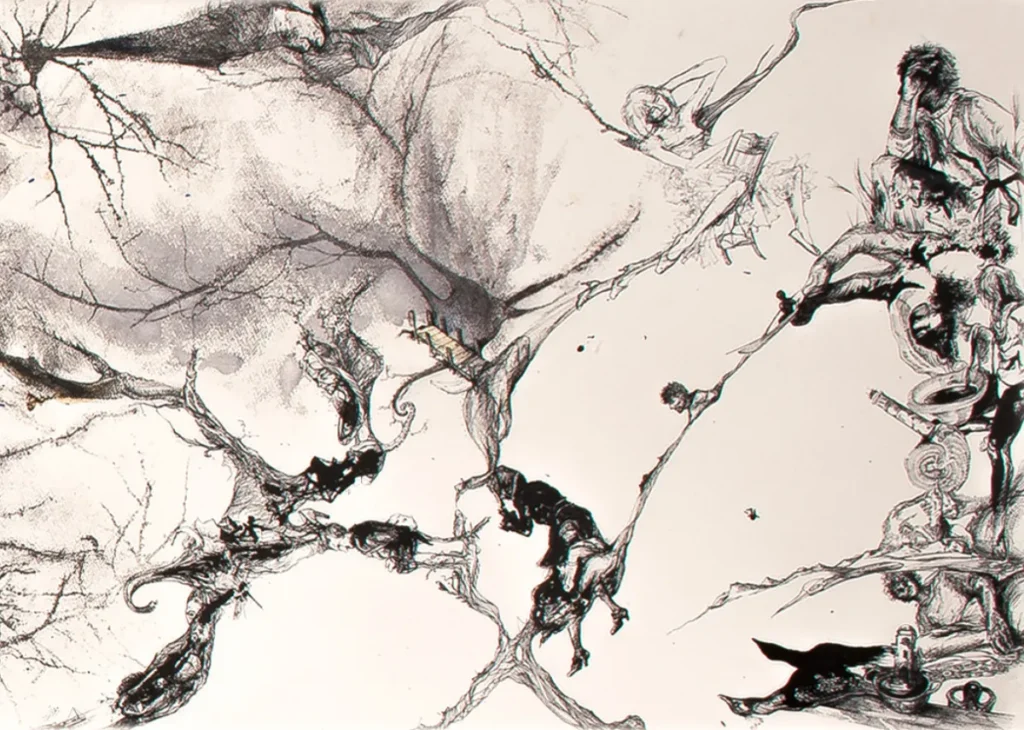
SPROUTING High Resolution Year 2015 Medium Mixed media, paper on plexiglass Size 83 X 71 cm All projects
“Saliency, La Memoria Cangiante”, la pittura che riflette su come plasmiamo i ricordi

Saliency, La Memoria Cangiante La pittura che riflette su come plasmiamo i ricordi Serena Scapagnini racconta Saliency, La Memoria Cangiante, l’installazione permanente creata per il Wu Tsai Institute di Yale: un viaggio tra neuroscienze, memoria e percezione per esplorare come il cervello selezioni, modifichi e ricrei continuamente i nostri ricordi. By Giorgia Basili Saliency, La Memoria Cangiante è la nuova installazione permanente di Serena Scapagnini, inaugurata il 4 giugno e concepita per il Wu Tsai Institute della Yale University. L’opera dell’artista si nutre degli studi su percezione e neuroscienze, approfondendo come il nostro cervello rielabori le esperienze vissute, selezioni e modifichi continuamente i ricordi immagazzinati. Quale ruolo gioca la memoria nella nostra percezione del tempo e dello spazio e sull’identità? Le fluttuazioni costanti della memoria mutano l’immagine che abbiamo del mondo e di noi stessi, ciò che scegliamo di mettere a fuoco, di cullare nella mente come ricordo da coltivare incide sulla qualità della nostra esistenza. E se la madeleine assaggiata dal protagonista de À la recherche du temps perdu ha il potere di risvegliare i suoi ricordi infantili, non è un caso. Qualcosa è rimasto attaccato a quel sapore e la traccia di ciò che è stato riemerge come un’onda, si lancia sulla riva della coscienza per poi ritirarsi e riaffiorare con nuovi frammenti di salsedine e conchiglia. In cosa è consistita la residenza interdisciplinare di un anno (2025–26) presso il Wu Tsai Institute, e come è nata? Sono stata invitata a lavorare presso il Wu Tsai Institute a Yale, a seguito del mio progetto collaborativo nei laboratori dello Yale Quantum Institute (YQI), a sua volta derivato da oltre dodici anni di lavoro condiviso con il Prof. Michael Higley, neuroscienziato della Yale University. Al YQI il dialogo con i ricercatori di fisica quantistica ha dato forma al progetto Superposition, articolato in un intero ciclo di opere: disegni, incisioni, pittura e installazioni, che esplorano la sovrapposizione quantistica, la capacità di una particella di esistere in più stati contemporaneamente, come metafora dell’identità, della memoria e della percezione. La memoria quantica è stata, in quell’esperienza e tuttora, al centro della mia ricerca, con opere che si focalizzano soprattutto sugli spazi di confine, tra la memoria e la sua dissoluzione, nel contatto con l’ambiente esterno, nel mescolarsi con il resto dell’universo. La mia ricerca sulla memoria è origine dell’invito del WTI, il più importante istituto a Yale che si occupa di neuroscienze e psicologia cognitiva.La mia ricerca sulla memoria è origine dell’invito del WTI, il più importante istituto a Yale che si occupa di neuroscienze e psicologia cognitiva. Come hai interagito con neuroscienziati e ricercatori cognitivi?Come hai interagito con neuroscienziati e ricercatori cognitivi? L’interazione si è articolata su tanti piani. Mi sono immersa nei laboratori in cui viene portata avanti una raffinatissima indagine che spazia tra la robotica e l’ingegneria cellulare, gli studi sulla percezione, sullo sviluppo cognitivo e neuronale; mi sono poi confrontata per diversi mesi con il team di ricercatori e neuroscienziati, in sinergia con il Direttore del WTI, il Prof. Nick Turk-Browne, per studiare la natura dei ricordi, la loro rievocazione e i fenomeni di salienza. Cosa ricordiamo? Quali sono i processi di selezione, che ruolo svolgono le emozioni e il corpo in questi meccanismi? Cosa si aggrappa alle pareti della nostra memoria e cosa scivola, riemerge, riaffiora e scompare? Così, dopo 12 anni di dialogo creativo con Higley Lab e il programma AiR al Quantum Institute, a cura di Florian Carle, è nato Saliency – La Memoria Cangiante, progetto che porta al culmine e abbraccia queste diverse tappe del percorso. Per Salienza si intende il processo cognitivo attraverso il quale alcuni dettagli emergono mentre altri si ritirano sullo sfondo percettivo. Cosa ti ha colpito di questo processo e cosa hai scoperto stando a contatto con i ricercatori? Quando Pablo Picasso si trovò di fronte alle pitture rupestri paleolitiche di Altamira, osservò come decine di migliaia di anni prima che emergessero teorie scientifiche sulla percezione, i primi esseri umani avessero già sviluppato strategie sofisticate per rendere visibile la matrice intrinseca dell’immagine. I bisonti, modellati dalla curvatura della pietra, intensificati attraverso il pigmento minerale e posizionati in modo da guidare lo sguardo dello spettatore, dimostrano una comprensione intuitiva dell’attenzione visiva. Lo studio della tradizione fenomenologica ci insegna che l’occhio non è solo un ricettore di luce; è un creatore di mondi. I dipinti di Altamira rappresentano una delle prime articolazioni umane della salienza, la distintiva qualità percettiva che permette ad alcune forme di emergere in primo piano mentre altre recedono. In questi mesi, nello specifico, al fianco dei ricercatori del WTI ho potuto studiare i fenomeni della salienza in relazione ai processi della mente, scoprendo di questa una natura non soltanto mutevole, ma anche capace di una rilevante plasticità biologica nei suoi meccanismi cellulari. Osservando la mutabilità della memoria, emerge come il recupero di un ricordo inesorabilmente lo modifichi. La mente seleziona alcuni dettagli e completa i collegamenti mancanti. L’immagine del ricordo si plasma come risultato di ciò che viene rivelato, ciò che viene nascosto e ciò che appare perduto. Così, le immagini sono sempre imperfette e potenzialmente mutabili, proprio come nell’opera Saliency. L’installazione presenta al centro un dipinto. L’onda blu incarna una riflessione su come il cervello selezioni, trasformi e ricostruisca l’esperienza nel corso del tempo. Vuoi spiegarci come hai messo in immagine e pigmento questo concetto? Dalle conversazioni al WTI sono emerse alcune domande, tra cui: quale ruolo gioca la memoria sulla nostra percezione del tempo e dello spazio? Quale sull’identità? Sappiamo che nulla è statico e che la memoria cambia nel tempo. Nel rievocare un ricordo, l’osservatore, interferisce inesorabilmente con l’oggetto del proprio sguardo. Partecipa, e dunque influenza, “riscrivendo” passato, presente e futuro. Così, nella stratificazione del lavoro, partendo dalla realizzazione della carta e ideando opere con tecnica mista che uniscano l’olio all’inchiostro, il pigmento puro alle tracce sottili del carboncino, ho cercato di evocare le fluttuazioni costanti della memoria e il profilo imperfetto dei suoi racconti. Ho voluto rendere omaggio a quell’architettura cognitiva in cui attenzione,
Quando l’arte italiana conquista il mondo. Serena Scapagnini a Yale
Quando l’arte italiana conquista il mondo Serena Scapagnini a Yale L’artista italiana firma un’installazione permanente frutto di una residenza interdisciplinare presso il Wu Tsai Institute della Yale University. By Massimo Mattioli L’assenza di artisti italiani nella Mostra Internazionale della Biennale di Venezia ha riacceso negli ultimi mesi una riflessione sul posizionamento dell’arte contemporanea italiana nei grandi circuiti globali. Eppure, al di fuori dei riflettori veneziani, non mancano esempi di creativi che riescono a costruire percorsi di riconoscimento e collaborazione all’interno di alcune delle più autorevoli istituzioni culturali e accademiche del mondo. Tra questi figura Serena Scapagnini, artista e studiosa romana che vive e lavora tra Roma e New York. Protagonista di un importante progetto presso il Wu Tsai Institute della Yale University. Il 4 giugno l’università statunitense inaugura infatti “Saliency, La Memoria Cangiante”, un’opera permanente nata al termine di una residenza interdisciplinare durata un anno. Sviluppata a stretto contatto con neuroscienziati, studiosi della cognizione e ricercatori. L’installazione rappresenta l’esito di un confronto tra linguaggi apparentemente distanti. Mettendo in relazione la pratica artistica con gli studi contemporanei sulla memoria, l’attenzione e i processi percettivi. Al centro del progetto si trova un grande dipinto che interpreta la memoria non come un archivio statico, ma come un fenomeno in continua trasformazione. Influenzato dalla selezione delle informazioni, dall’esperienza e dalla capacità del cervello di riorganizzare continuamente i propri contenuti. Ricordo e riconoscimento L’opera prende forma attraverso riferimenti visivi derivati dalle neuroscienze. Una grande struttura ondulata blu richiama le forme dell’ippocampo e alcune sezioni anatomiche del cervello, elaborate grazie al dialogo con gli scienziati dell’istituto. Sulla superficie emergono immagini e tracce che sembrano affiorare e scomparire. Invitando lo spettatore a un esercizio di osservazione che riproduce simbolicamente i meccanismi del ricordo e del riconoscimento. Secondo la ricerca scientifica contemporanea, infatti, ogni recupero della memoria comporta una trasformazione del ricordo stesso. È proprio questo processo che Scapagnini traduce in termini visivi, suggerendo una vicinanza tra il lavoro dell’artista e quello dello scienziato. Entrambi indagano ciò che appare nascosto, selezionano informazioni e costruiscono nuove interpretazioni della realtà. Il progetto si inserisce in un percorso di ricerca che l’artista porta avanti da anni sul rapporto tra arte e scienza avanzata. L’esperienza al Wu Tsai Institute segue infatti la collaborazione con lo Yale Quantum Institute, culminata nel 2025 con una serie di installazioni dedicate alle implicazioni culturali e percettive della fisica quantistica. Un lavoro che oggi prosegue mettendo in dialogo neuroscienze e studi sulla coscienza. Contesti internazionali L’inaugurazione dell’opera è accompagnata da un incontro pubblico con i ricercatori che hanno contribuito al progetto. Con interventi, tra gli altri, del direttore del Wu Tsai Institute Nick Turk-Browne e del neuroscienziato Mike Higley. Con il quale l’artista collabora da oltre un decennio. La presenza permanente di “Saliency, La Memoria Cangiante” negli spazi di Yale conferma come alcune delle esperienze più innovative dell’arte italiana contemporanea trovino oggi terreno fertile all’interno di contesti internazionali dove la produzione artistica dialoga direttamente con la ricerca scientifica e tecnologica. Un segnale significativo in un momento in cui il dibattito sul peso degli artisti italiani nelle grandi esposizioni internazionali resta particolarmente acceso. The absence of Italian artists from the International Exhibition of the Venice Biennale has reignited, in recent months, a broader discussion about the position of contemporary Italian art within major global circuits. Yet beyond the spotlight of Venice, there is no shortage of examples of artists who have successfully built paths of recognition and collaboration within some of the world’s most prestigious cultural and academic institutions. Among them is Serena Scapagnini, a Rome-born artist and scholar who lives and works between Rome and New York. And who is currently protagonist of a significant project at Yale University’s Wu Tsai Institute. On June 4, the American university unveils Saliency, La Memoria Cangiante (Saliency, The Shifting Memory), a permanent artwork developed at the conclusion of a year-long interdisciplinary residency carried out in close collaboration with neuroscientists, cognitive scholars, and researchers. The installation is the outcome of a dialogue between seemingly distant fields, bringing artistic practice into conversation with contemporary studies of memory, attention, and perceptual processes. At the heart of the project is a large-scale painting that interprets memory not as a static archive, but as a phenomenon in constant transformation, shaped by the selection of information, lived experience, and the brain’s ongoing capacity to reorganize its contents. Memory and Recognition The work takes shape through visual references drawn from neuroscience. A large undulating blue structure evokes the forms of the hippocampus and anatomical sections of the brain, developed through dialogue with the Institute’s scientists. Across its surface, images and traces emerge and disappear, inviting viewers into an act of observation that symbolically mirrors the mechanisms of memory and recognition. Contemporary scientific research suggests that every act of recalling a memory also transforms that memory itself. It is precisely this process that Scapagnini translates into visual terms. Proposing a close affinity between the work of the artist and that of the scientist. Both investigate what remains hidden, select information, and construct new interpretations of reality. The project forms part of a broader line of inquiry that the artist has pursued for years at the intersection of art and advanced scientific research. Her experience at the Wu Tsai Institute follows a collaboration with the Yale Quantum Institute, which culminated in 2025 with a series of installations exploring the cultural and perceptual implications of quantum physics. This investigation now continues through a dialogue with neuroscience and consciousness studies. International Contexts The inauguration of the work will be accompanied by a public conversation with the researchers who contributed to the project, including Wu Tsai Institute Director Nick Turk-Browne and neuroscientist Mike Higley. With whom the artist has collaborated for more than a decade. The permanent presence of Saliency, La Memoria Cangiante within Yale’s spaces confirms how some of the most innovative experiences in contemporary Italian art are currently finding fertile ground in international contexts where artistic production engages directly with scientific and technological research. It is a significant signal
Five Things to Know… Art, emotion, and quantum error correction
Five Things to Know… Art, emotion, and quantum error correction Serena Scapagnini, the most recent Yale Quantum Institute artist-in-residence, will headline two events at this month’s International Festival of Arts and Ideas. By Jim Shelton Great works of art create meaningful connections with the beholder that grow deeper the more you experience them. Quantum error correction does the same thing — swapping in qubits for brushstrokes, musical notes, or stage directions. This subtle tether between art and science is the central focus of the artist-in-residence program of the Yale Quantum Institute (YQI). The program’s latest collaboration will be featured at two events at the International Festival of Arts & Ideas, currently underway in New Haven, as well as three installations on display during the festival. Serena Scapagnini, the current artist-in-residence, worked with quantum physics researcher Harshvardhan “Harsh” Babla, a graduate student in the lab of Shruti Puri. Specifically, Babla and Scapagnini created visual representations of quantum concepts from Babla’s research. “Quantum physics is, at best, abstract for many people, so talking about quantum error correction — in which researchers attempt to correct errors that occur during quantum computation — is quite the challenge,” said Florian Carle, YQI’s managing director. “Serena’s medium is deeply physical: metal plates engraved with quantum states, handmade paper, drawings, and paintings. She is embodying abstract concepts in matter, representing the complex plots of researchers into areal and spiraling sculptures.” On June 21 at 1 p.m. at the Humanities Quadrangle, Scapagnini will be on hand for the U.S. premiere of the documentary film “Serena Scapagnini — The Space Beyond,” followed by a discussion featuring Scapagnini, Babla, Carle, gerontology educator Donna Fedus, and Yale neuroscientist Michael Higley. On June 24 at 2 p.m., Scapagnini and Carle will lead a walking tour of Scapagnini’s artworks at installations on the New Haven Green, the Robert B. Haas Family Arts Library (180 York St.), and YQI (17 Hillhouse Ave.). Yale News talked with Scapagnini and Babla about their collaboration. Here are five takeaways: Their work together was as much about connections and feelings as it was about quantum physics. “This collaboration primarily appealed to me as a bridge between science and emotion, using visuals to spark curiosity and connect with a broader audience,” Babla said. Added Scapagnini: “I believe that our collaboration was able to reveal a shared ground, on different levels.” Part of her discussions with Babla and other YQI scientists involved the transient nature of memory — a topic she has explored since 2012. “The information encoded in quantum memory, with its natural decay, is never destroyed,” she said. “It is elsewhere, and the measured error is a sign of its mixing with the rest of the universe. Thus, information is always in the universe, even when it has left memory.” The resulting work highlights the quantum phenomenon of superposition. “Superposition” occurs when two particles of light, for example, exist in multiple states simultaneously, such as being in two places at once or moving with two distinct momenta at the same time, Babla said. “Superposition creates intricate interference patterns, which are the hallmark of quantum mechanics,” he said. “Serena’s work vividly showcases these patterns. She also explores how these patterns are disrupted by undesired interactions with the environment. “A corresponding phenomenon occurs in quantum optics, where superposition allows light to store energy across multiple configurations at once,” he noted. “These configurations correspond to energy stored in the electric field, or in the magnetic field, or in both. In our lab, these states are crucial for storing and correcting quantum information.” Scapagnini replicates the intricacies of quantum states, in part, through different densities of materials. “From the body of pure pigment and of paint to the liquid dimensions of inks, to the more airy and rarefied density of mineral powders, the geometric horizon underlying the installations mixes with the elusive mimesis of the drawings,” Scapagnini said. “The project that we shared and created together connects these different material densities, from the aluminum plate to the paper that was handmade for the work, up to the engraved metal soul that is inside each single element,” she said. “The work that emerged connects these different densities in a choral way, to suggest quantum intuition, as an internal law to the phenomena of the world.” Yale will figure prominently in the June 21 A&I event, both in the documentary and during the panel discussion.Yale will figure prominently in the June 21 A&I event, both in the documentary and during the panel discussion. “Serena Scapagnini — The Space Beyond,” a 21-minute documentary film directed by Nicola Campiotti, includes several scenes of Scapagnini talking with researchers at YQI during her residency. Those conversations, along with previous work in the Higley Lab at Yale School of Medicine — which explores the development, organization, and function of the mammalian neocortex — have informed much of Scapagnini’s work. The panel discussion will highlight common themes of both experiences, such as the parallels between coping with human memory loss and correcting quantum errors. One of the new art installations mimics the way quantum information can be altered by observation. The last stop on the June 24 walking tour will be “Refractions,” an installation on display at the Robert B. Haas Family Arts Library on York Street. There, suspended in the atrium, are 10 hand-made paper elements that each cover a thin copper plate that is engraved with a representation of a quantum state. Thus, the installation reminds us, it is not possible to view the quantum states without affecting the surrounding elements. See the full article All press
L’invisibile prende forma: lo sguardo di Cardani e Scapagnini
L’invisibile prende forma Lo sguardo di Cardani e Scapagnini Nella nuova puntata di STEAM – Sostantivo femminile esploriamo uno dei territori più affascinanti e sfuggenti della conoscenza: la fisica quantistica. Lo spunto è l’Anno Internazionale delle Scienze e delle Tecnologie Quantistiche, proclamato dalle Nazioni Unite per il 2025. Eleonora Diquattro Nella nuova puntata di STEAM – Sostantivo femminile esploriamo uno dei territori più affascinanti e sfuggenti della conoscenza: la fisica quantistica. Lo spunto è l’Anno Internazionale delle Scienze e delle Tecnologie Quantistiche, proclamato dalle Nazioni Unite per il 2025. Un’occasione per fermarsi e riflettere su quanto queste teorie, spesso invisibili ma potenti, abbiano già trasformato — e continueranno a trasformare — la nostra società e le nostre vite, spesso senza che ce ne rendiamo conto. La fisica quantistica non è solo una rivoluzione scientifica: è un cambio di sguardo sul mondo. Ci parla di particelle che possono esistere in più stati allo stesso tempo, di connessioni profonde tra elementi lontanissimi, di probabilità che sfidano le certezze. Una fisica che sembra quasi poetica, eppure è concreta, misurabile, reale. Tanto da essere alla base di tecnologie che stanno già ridefinendo il presente: computer quantistici, superconduttori, sensori ultrasensibili. Nella “complessità” di questo argomento partiamo mossi dalla curiosità, seguendo il suono di un criostato, nascosto a 1.400 metri sotto la superficie terrestre, nel cuore dei Laboratori del Gran Sasso. Qui, nel cosiddetto “silenzio cosmico” – uno degli ambienti più privi di radioattività al mondo – un gruppo di ricercatori studia come l’ambiente influenzi il comportamento dei qubit, le unità fondamentali dell’informazione quantistica. Ma la nostra esplorazione non si ferma qui. Risaliamo dai sotterranei, oltrepassiamo l’oceano e arriviamo a Yale, dove un’artista e un fisico ricercatore intrecciano arte e scienza in un dialogo condiviso dal quale prendono forma opere che traducono visivamente il paradosso quantistico del “gatto di Schrödinger”, rendendo percepibile l’incertezza e la coesistenza nella sovrapposizione. Le protagoniste e nostre “esploratrici” d’eccezione di questa puntata sono: Laura Cardani e Serena Scapagnini. Quella di Laura e Serena è la storia di due percorsi d’eccellenza che si sfiorano e si completano, come particelle in sovrapposizione quantistica. Ognuna esplora l’invisibile con strumenti differenti: il laboratorio e lo studio, il qubit e il pigmento, la misura e l’intuizione. Due visioni che dialogano, ciascuna capace di illuminare l’altra. Laura Cardani, oggi prima ricercatrice all’INFN (Istituto Nazionale di Fisica Nucleare), ha iniziato il suo percorso accademico quasi per caso. Diplomata al liceo linguistico, si immaginava a studiare Lingue. Poi, l’incontro con un professore di fisica appassionato di filosofia e arte le ha mostrato che scienza e umanesimo non sono mondi separati. Da lì, la scelta di laurearsi in Fisica all’Università di Milano-Bicocca e proseguire con un dottorato a Roma “La Sapienza”, specializzandosi in fisica delle particelle. Il suo lavoro si svolge inizialmente in laboratori sotterranei, dove rivelatori ipersensibili cercano eventi rari, schermati dalla radioattività dell’ambiente, degli strumenti e persino degli esseri umani. Poi arriva l’intuizione che cambia tutto: se la radioattività è un problema per questi esperimenti delicatissimi, non potrebbe esserlo anche per i computer quantistici, che devono restare isolati dal mondo per funzionare? Inizialmente, l’idea viene accolta con scetticismo. Ma Laura insiste, propone esperimenti, cerca collaborazioni. Il progetto DEMETRA documenta che la radioattività ambientale danneggia i qubit, compromettendo la loro coerenza. “Con DEMETRA abbiamo dimostrato che i qubits sono effettivamente molto sensibili alla radioattività e abbiamo sviluppato delle strategie per ridurne gli effetti.” – ha sottolineato la ricercatrice durante il nostro incontro. Google replica uno dei suoi studi sul processore Sycamore e conferma i risultati. Oggi Laura coordina un gruppo di ricerca che lavora per proteggere i computer quantistici dagli effetti dei raggi cosmici, ma guarda anche oltre: e se i qubit potessero diventare rivelatori delle particelle più elusive dell’universo, come la materia oscura… “Penso che la creatività sia l’ingrediente più prezioso per fare ricerca non solo per risolvere i problemi che affrontiamo ogni giorno, ma soprattutto per immaginare nuove direzioni da esplorare. Nel mio caso, per esempio, ho sempre lavorato su rivelatori a bassissima radioattività. A un certo punto, mi è venuta questa idea un po’ eretica: e se la radioattività fosse un problema anche per i computer quantistici? Non ne sapevo quasi nulla, ma quell’intuizione ha dato vita a un intero nuovo filone di ricerca…Anni dopo mi hanno addirittura confessato che all’inizio fra loro mi chiamavano Lady Chernobyl per prendermi in giro per questa idea!” – conclude Laura con un sorriso consapevolmente ironico. Dall’altra parte dell’Atlantico, un altro sguardo si rivolge all’invisibile. È quello di Serena Scapagnini, artista visiva romana con una formazione multidisciplinare: laureata in Teoria dell’Arte, Semiotica e Storia delle Religioni alla Sapienza, ha poi studiato Storia dell’Arte Medievale a Siena e pittura alla School of Visual Arts di New York. Da oltre un decennio, collabora con il neuroscienziato Michael Higley a Yale, traducendo in linguaggio visivo i processi sinaptici e la memoria. Serena qual è il filo rosso che unisce arte medievale, neuroscienze e meccanica quantistica nel tuo percorso? Come convivono questi mondi apparentemente distanti nella tua pratica visiva? “Mi guardo intorno nel mio studio dove disegni e scrolls, piccole e più monumentali carte fatte a mano si srotolano da una densità ad un’altra e mi accorgo che il filo rosso che lega queste opere, e la ricerca che le anima, è la stratificazione, la tensione tra diverse densità. Mi sono laureata in Storia dell’Arte medievale. L’esaltazione dei piani, che nelle opere d’arte tardoantica si articola entro una propria ripartizione netta, è evocatrice dei diversi livelli dell’universo e del procedere dello Spirito da un piano all’altro. L’attenzione sul procedere graduale dei piani raffigurati, in rapporto alla concezione stratificata dell’universo, incanalando un principio spirituale, tende naturalmente a sistematizzare la forma su un piano gerarchico, fortemente simbolico, architettura ideale di una corrispettiva visione cosmica.” Oggi è la prima artista italiana selezionata per il prestigioso Artist-in-Residence Program dello Yale Quantum Institute. Il suo progetto, SUPERPOSITION, è composto da tre installazioni site-specific che esplorano la sovrapposizione quantistica – la capacità di una particella di esistere in più